The Concorde Simulator
Concorde Simulator History:
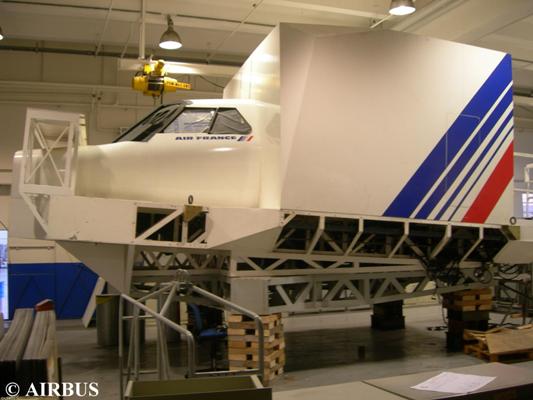
 Construction of the the British Airways Concorde Simulator began in 1974 and was completed the following year at a cost of £3 million (almost £40 million at today's prices). It entered service training BA flight crews in March 1976. It was a joint venture between the Link-Miles division of the Singer Company (UK) Limited, who built the cockpit and the hydraulic platfom, and Redifon Flight Simulation who were responsible for the computer, interface and visual system. The sim was located at the British Aircraft Corporation's training centre at Filton, Bristol. Air France had their own Concorde simulator and this was built by Le Matériel Telephonique (LMT) and was based at the Aéroformation training school in Toulouse (see photo).
The BA sim stood on a motion system comprising of six electrically controlled hydraulic jacks. The jacks allowed for six axes of motion: pitch, roll, yaw, heave, sway and surge. Originally the view out of the cockpit windows was generated by a Redifon 'Duoview' closed-circuit TV system which consisted of a camera moving over 3 large model landscapes that were mounted vertically on the wall of an adjacent room. The largest was a 1/2000 scale model that depicted the runways and surrounding area of an airport not dissimilar to Heathrow. Also included was a realistic cloud-top model for high altitude flight and, at the other extreme, a model of an airport apron to allow for the training of the nuances of taxiing Concorde. As the camera tracked over the models, the images were displayed on cathode-ray-tube displays in front of the cockpit windows.
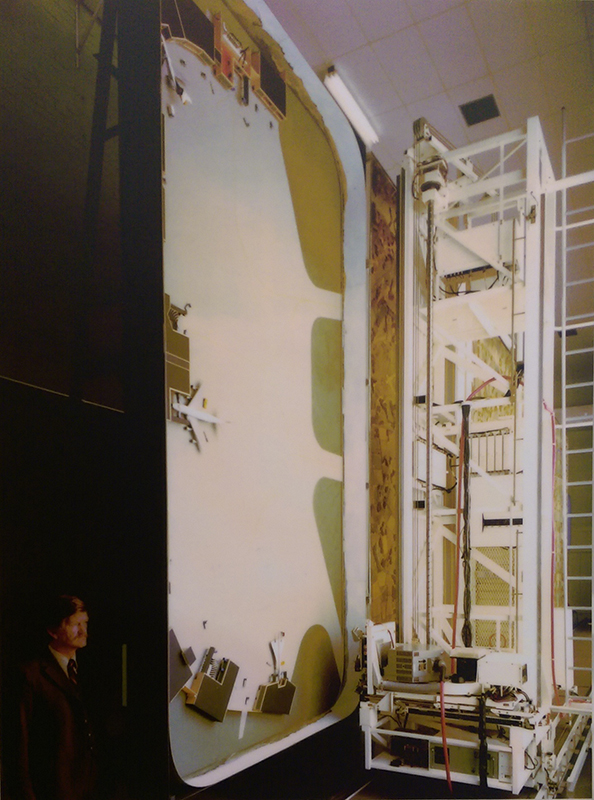
 By 1987 the sim had undergone a major visual system upgrade, at a further cost of £3 million, and which brought it in line with all the best sims around the world. Two thirds of the upgrade cost went on a Rediffusion SP-X 500/WIDE full-daylight panoramic visual system. This gave pilots a 150° by 40° view of projected, computer-generated images. The updates to the system also vastly increased the scope of the artificial landscape that it was possible to fly over. The original sim setup was limited to the single airport and surrounding scenery of the large models, whereas the new system enabled pilots to 'fly' to many of the major airports around the world.
 The large hydraulic jacks that gave the sim its motion meant that it stood about 15 feet in the air. Because of this, access to the simulator was via a retractable bridge. Once inside the simulator cockpit, pilots would immediately feel like they were on the flight deck of a real Concorde. The instrumentation, lighting and functionality of the systems matching the real aircraft. The simulator was operated by technicians who, as well as acting as air traffic controllers, would program the system with artificial fuel and passenger loads, weather variations and also generate a variety of aircraft system and hardware failures for the flight crew to deal with. Every emergency procedure was taught and practised. Engine failures, pressurisation failure followed by emergency decent, failure of electrical signalling to the flying controls, and even a cockpit fire, could be simulated.
 Flying the simulator was said to be very realistic. The response to control movement was extremely accurate, all the instruments behaved as they would in the real aircraft and ambient and system noises played through speakers inside the sim added an extra bit of realism. Added to all this was the motion system which enabled the pilots inside to experience the usual sensations of flight - acceleration, turning, climbing and descending.
Despite its accuracy and realism, the Concorde simulator was not as advanced as the more sophisticated flight simulators of today and consequently it was not 'zero-hour rated'. Zero-hour rated simulators allow converting pilots to carry out their first flight in the real aircraft while carrying passengers - albeit under the supervision of a highly experienced training Captain. Despite this, the Concorde simulator was still an extremely effective crew trainer. The simulator training course lasted a total of 76 hours (19 x 4-hour sessions) - which was roughly double the length of the Boeing 747 course - and over the 28 years the simulator was in service, a total of 134 pilots and 57 flight engineers were trained on it.
The Concorde Simulator at Brooklands:
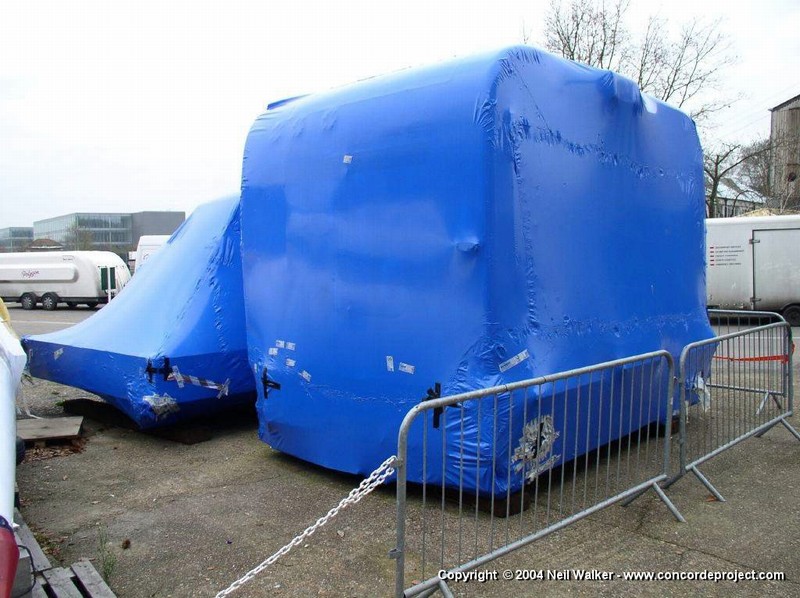
 The Filton based simulator was decommissioned by British Airways in early 2004 - a few months after they ceased Concorde operations - and it was subsequently announced that it was to be loaned to Brooklands Museum. Later that year it was transported to the museum in two halves (see photo). Originally the plan was for just the cockpit section to go on display but a plan was soon formed to bring the simulator back to life, although, when it was decommissioned the sim's motion system was scrapped so it is now a fixed base simulator.
In January 2008 the simulator was moved into a newly refurbished room in a building next to Concorde Delta Golf and work got underway to rejoin the two halves and get the sim operational again. In June 2009 the simulator was officially opened to the public and it is now open for viewing, when operational constraints allow.
 The project to get the sim operational again was a joint venture between the University of Surrey (UniS) and the Engineering and Physical Sciences Research Council (EPSRC). It involved the integration of the existing simulator cockpit with modern flight simulation software. This was engineered by XPI Simulation Ltd, who are specialists in simulation software and hardware.
The simulated environment is projected onto a large screen in front of the cockpit windows and Concorde is 'flown' using the original flight controls and system controls inside the simulator. This includes the control columns, trim switches, rudder pedals, throttles, reheat switches, landing gear lever, toe brakes and the nose and visor lever. Alongside this, nearly all of the instruments on the pilots panel are also operational. This includes the ADIs, ASIs, HSIs, VSIs, primary engine instruments, DME indicators, pressure altimeters, radio altimeters and also the famous Machmeters. By the end of 2011, sections of the flight engineers panel had also been brought back to life as well. This includes Concorde's complicated fuel control system.
Simulator Visual System Upgrade:
 Over several months during Spring and Summer 2013 the simulator underwent a major upgrade of the visual system. This actually involved refitting the back projection screen and mirror from the original WIDE system that was fitted to the simulator when it was operational at Filton. These two large components were removed from the sim in 2003 and placed in storage at British Airways Flight Training facility at Heathrow airport, with a view to them being kept as spares for some of the airline's other simulators. However, in 2011 BA decided they were no longer required and they offered both the screen and mirror to Brooklands. They were transported to the museum in early 2012.
Refitting the back projection screen and mirror was both technically and logistically complex and took around 4 months to be completed by museum volunteers. It involved the partial dismantling of the simulator to remove the existing canvas projection screen and blackout frame, the relocation of all the computer and equipment racks and actually moving the simulator itself several feet to accommodate the large mirror. The screen and mirror of the WIDE system create what is known as a collimated display. A collimated display is focused to infinity and therefore provides the projected image with much more depth than one projected onto a normal flat screen. It also allows the projected images to appear the same to both pilots, eliminating distortion and parallax errors. The images are first projected on to the translucent back projection screen mounted above the cockpit and this image is reflected by the large concave mirror in front of the cockpit windows. The mirror surface is not glass - which would be both too heavy and very expensive - but actually a Mylar film which is drawn flat into a frame by a vacuum pump. Not only has the refitting of the original projection system greatly improved the visuals viewed through the cockpit windows, but, from a historical point of view, it has also returned the simulator to it's original operational configuration.
Flying the Concorde Simulator:
Fancy the chance to fly the Concorde Simulator, with tuition from a real Concorde pilot? Brooklands Museum offers a limited number of special events which can include up to 30 minutes actually flying the Concorde Simulator, plus a 3-course meal with a former British Airways Concorde Captain and a visit to the real Concorde cockpit on G‑BBDG. The simulator flying experiences are suitable for all abilities, whether you are a complete beginner or a professional pilot. More details on the packages available can be found here.
Please note that I am personally unable to take bookings for the simulator experiences or offer advice on any booking related queries. Instead, please contact the museum directly on 01932 857381, or by email at flyconcorde@brooklandsmuseum.com.
To get an idea of what to expect during your time at the controls of the simulator, check out the following two videos of a takeoff and a landing from/to the old Kai Tak airport. The videos were filmed during a 'Gold' simulator experience with Captain Terry Henderson in the co-pilot's seat:
Flight Simulator Experience videos:
Simulator restoration photos:
Simulator Visual System Upgrade - Mirror Re-skin (19th/20th May 2013)
Simulator Visual System Upgrade - Dismantling (1st/8th June 2013)
Simulator Visual System Upgrade - Mirror and BP Screen Fitting (27th June 2013)
Simulator Visual System Upgrade - Sim Move and Petal Fitting (28th June 2013)
Simulator Visual System Upgrade - Sim Recommissioning (July/August 2013)
Historic simulator videos:
Brooklands simulator videos:
French simulator photos: